Un Super-Volcan, le Laacher See, qui a déjà provoqué la plus puissante Éruption d'Europe, il y a 13.000 ans, montre qu'il est toujours Actif sous l'Allemagne !

Il y a treize mille ans, au cœur de l'Allemagne actuelle, s'est produite l'éruption la plus puissante d'Europe des cent mille dernières années, plus vaste que le Vésuve, comparable en intensité au Pinatubo.
Les cendres ont atteint la Scandinavie et le nord de l'Italie, le Rhin a été barré par des lahars, et selon l'une des hypothèses, le climat de l'hémisphère nord en a été bouleversé pendant douze cents ans.
Depuis deux mille treize, les sismographes installés sous le lac de Laach enregistrent des séismes profonds à basse fréquence — un signal qui, en volcanologie, signifie que le magma est en mouvement.
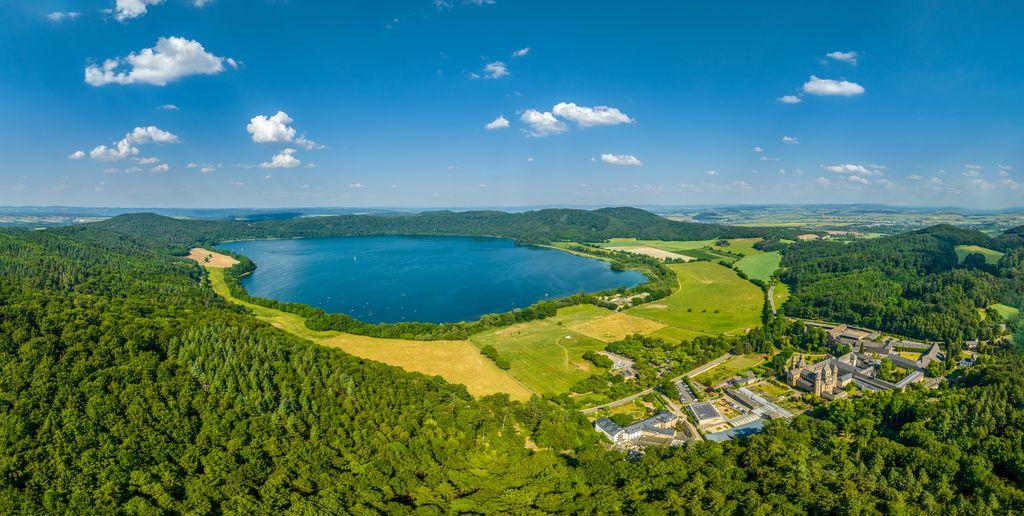
Dans ce film : la reconstitution de la catastrophe, la controverse scientifique sur la date exacte de l'éruption, et une évaluation sans complaisance de ce qui adviendrait de l'Europe moderne si le volcan se réveillait.
00:00 Un supervolcan au cœur de l'Europe
00:48 Laacher See parmi les grandes éruptions d'Europe
03:40 Hans-Ulrich Schmincke et la reconstitution de la catastrophe
04:15 Comment a commencé l'éruption il y a 13 000 ans
05:38 Coulées pyroclastiques et Rhin barré
07:07 La bataille de la date : Reinig contre Blockley
09:15 130 ans et l'énigme du Dryas récent
10:22 Soufre, carottes de glace et trace arctique
11:13 Mofettes : le souffle froid du volcan
12:42 Le geyser froid d'Andernach
14:34 Un grondement profond sous le lac
16:36 Séismes DLF et magma en mouvement
18:13 Pourquoi Laacher See ne peut pas être considéré comme mort
19:16 Un scénario de nouvelle éruption pour l'Europe
22:50 L'héritage de Schmincke et la question centrale
Sources :
• Reinig, F., Wacker, L., Jöris, O., et al. (2021). Precise date for the Laacher See eruption synchronizes the Younger Dryas. Nature, 595, 66–69.
• Baldini, J. U. L., Brown, R. J., Wadsworth, F. B., Paine, A. R., Campbell, J. W., Green, C. E., Mawdsley, N., & Baldini, L. M. (2023). Possible magmatic CO2 influence on the Laacher See eruption date. Nature, 619, E1–E2.
• Reinig, F., Wacker, L., Jöris, O., et al. (2023). Reply to: Possible magmatic CO2 influence on the Laacher See eruption date. Nature, 619, E3–E8.
• Sigl, M., et al. (2025). Discovery of Laacher See eruption in speleothem record synchronizes Greenland and central European Late Glacial climate change. Science Advances.
• Schmincke, H.-U., Park, C., & Harms, E. (1999). Evolution and environmental impacts of the eruption of Laacher See Volcano (Germany) 12,900 a BP. Quaternary International, 61(1), 61–72. Schmincke, H.-U. (2014). Vulkane der Eifel: Aufbau, Entstehung und heutige Bedeutung (2nd ed.).
• Springer Spektrum. Hensch, M., Dahm, T., Ritter, J., et al. (2019). Deep low-frequency earthquakes reveal ongoing magmatic recharge beneath Laacher See Volcano (Eifel, Germany). Geophysical Journal International, 216(3), 2025–2036.
• Hensch, M., et al. (2024). Seismological monitoring of magmatic and tectonic earthquakes in the East Eifel Volcanic Field, Germany. Journal of Seismology.
• Goepel, A., Lonschinski, M., Viereck, L., Büchel, G., & Kukowski, N. (2015). Volcano-tectonic structures and CO2-degassing patterns in the Laacher See basin, Germany. International Journal of Earth Sciences, 104(4).
• Bräuer, K., Kämpf, H., Niedermann, S., & Strauch, G. (2013). Indications for the existence of different magmatic reservoirs beneath the Eifel area (Germany): A multi-isotope (C, N, He, Ne, Ar) approach. Chemical Geology, 356.
• Riede, F. (2014). Eruptions and ruptures – a social network perspective on vulnerability and impact of the Laacher See eruption (c. 13,000 BP) on Late Glacial hunter-gatherers in northern Europe. Archaeological Review from Cambridge, 29(1), 67–102.
• Riede, F., et al. (2017). Assessing volcanic risk in regions with low frequency eruptions: the Laacher See case study. EGU General Assembly 2017, abstract EGU2017-10045.